
Introducing the Doppler flow meter, a remarkable tool that harnesses the Doppler effect to measure fluid flow. This technology has revolutionized various fields, including medicine and industry, providing invaluable insights into fluid dynamics. Let’s delve into the world of Doppler flow meters, exploring their principles, applications, and data analysis techniques.
Doppler flow meters employ the Doppler effect, which describes the change in frequency of a wave when there is relative motion between the source and observer. In the case of Doppler flow meters, the source is an ultrasonic or electromagnetic wave, and the observer is the receiver. As the wave interacts with the moving fluid, its frequency shifts, providing information about the fluid’s velocity.
Contents
Doppler Flow Meter Fundamentals

Doppler flow meters utilize the Doppler effect to measure the velocity of fluids. The Doppler effect is the change in frequency of a wave in relation to an observer who is moving relative to the wave source. In Doppler flow meters, ultrasonic waves are transmitted into the fluid, and the reflected waves are detected by a receiver. The difference in frequency between the transmitted and received waves is proportional to the velocity of the fluid.
Types of Doppler Flow Meters
There are two main types of Doppler flow meters: transit-time and continuous-wave. Transit-time flow meters measure the time it takes for an ultrasonic pulse to travel from the transmitter to the receiver. Continuous-wave flow meters measure the frequency shift of the reflected ultrasonic waves.
Applications of Doppler Flow Meters
Doppler flow meters are used in a wide variety of industries, including the following:
- Water and wastewater treatment
- Oil and gas production
- Chemical processing
- Medical applications
Doppler Flow Meter Design and Components
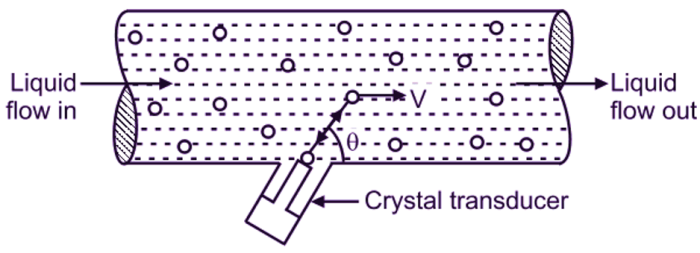
Doppler flow meters are designed to measure the velocity of a fluid flowing through a pipe or channel. They achieve this by transmitting a high-frequency sound wave into the fluid and measuring the frequency shift of the reflected wave. The frequency shift is proportional to the velocity of the fluid, and this relationship can be used to calculate the flow rate.
The key components of a Doppler flow meter include:
- Transducer: The transducer is the component that transmits and receives the sound waves. It is typically mounted on the outside of the pipe or channel.
- Signal processor: The signal processor is the component that measures the frequency shift of the reflected wave. It is typically located in a separate enclosure from the transducer.
- Display: The display is the component that shows the flow rate measurement. It is typically located in a separate enclosure from the signal processor.
The design of a Doppler flow meter is critical to its performance. The following are some of the design considerations that must be taken into account:
- Frequency of the sound wave: The frequency of the sound wave must be high enough to be reflected by the fluid, but not so high that it is attenuated by the fluid.
- Angle of the transducer: The angle of the transducer must be such that the sound wave is reflected directly back to the transducer.
- Diameter of the pipe or channel: The diameter of the pipe or channel must be large enough to allow the sound wave to be transmitted and reflected without being attenuated.
- Flow rate: The flow rate of the fluid must be within the range that the flow meter is designed to measure.
There have been a number of innovative Doppler flow meter designs developed in recent years. These designs have improved the accuracy, reliability, and versatility of Doppler flow meters.
One example of an innovative Doppler flow meter design is the use of a dual-frequency transducer. This type of transducer transmits two sound waves at different frequencies. The frequency shift of each wave is measured, and the difference between the two frequency shifts is used to calculate the flow rate. This design is more accurate than traditional Doppler flow meters because it is less sensitive to changes in the fluid temperature and density.
Another example of an innovative Doppler flow meter design is the use of a phased array transducer. This type of transducer uses multiple sound waves that are transmitted at different angles. The reflected waves are combined to create a more focused beam, which improves the accuracy and reliability of the flow measurement.
Doppler Flow Meter Applications in Medical Field

Doppler flow meters play a vital role in the medical field, providing non-invasive and accurate measurements of blood flow velocity. Their applications extend across various medical specialties, including cardiology, neurology, and vascular surgery.
Cardiology
In cardiology, Doppler flow meters are used extensively to assess heart function and diagnose cardiovascular conditions. They enable the evaluation of blood flow patterns within the heart chambers, valves, and coronary arteries. Doppler echocardiography, for instance, utilizes sound waves to create images of the heart and measure blood flow velocities, aiding in the diagnosis of valvular heart disease, congenital heart defects, and coronary artery disease.
Neurology
In neurology, Doppler flow meters are employed to study blood flow in the brain and detect abnormalities that may indicate neurological disorders. Transcranial Doppler (TCD) is a non-invasive technique that uses Doppler ultrasound to measure blood flow velocity in the cerebral arteries. TCD is valuable in assessing cerebral blood flow and diagnosing conditions such as stroke, vasospasm, and carotid artery stenosis.
Other Medical Applications
Beyond cardiology and neurology, Doppler flow meters find applications in various other medical specialties, including:
– Vascular Surgery: Assessing blood flow in peripheral arteries and veins, aiding in the diagnosis and treatment of vascular diseases.
– Nephrology: Evaluating renal blood flow and detecting abnormalities in kidney function.
– Obstetrics and Gynecology: Monitoring fetal blood flow during pregnancy and assessing uterine blood flow in conditions like preeclampsia.
Doppler Flow Meter Applications in Industrial Settings
Doppler flow meters find extensive applications in various industrial settings, offering accurate and non-invasive flow measurement solutions. Their ability to measure flow rates without obstructing the flow path makes them ideal for a wide range of industrial processes.
Flow Measurement
Doppler flow meters are widely used for measuring flow rates in pipes and channels. They provide real-time flow data, enabling precise control and optimization of industrial processes. This information is crucial for managing fluid transfer, optimizing energy consumption, and ensuring efficient operation.
Leak Detection
Doppler flow meters excel in detecting leaks in pipelines and storage tanks. By monitoring flow patterns, they can identify even small leaks that may otherwise go unnoticed. This capability helps prevent fluid loss, minimizes environmental impact, and ensures the safety and integrity of industrial systems.
Other Industrial Applications
- Condition Monitoring: Doppler flow meters monitor flow conditions in rotating machinery, such as pumps and turbines, to detect potential problems early on, preventing catastrophic failures.
- Fluid Characterization: Doppler flow meters can determine fluid properties, such as density and viscosity, providing valuable insights for process optimization.
- Non-Contact Flow Measurement: Doppler flow meters measure flow rates without making physical contact with the fluid, making them suitable for hazardous or inaccessible environments.
Doppler Flow Meter Data Analysis and Interpretation

Analyzing and interpreting Doppler flow meter data involves techniques to extract meaningful information about fluid flow characteristics. Proper interpretation is crucial to ensure accurate measurements and reliable conclusions.
Data Analysis Techniques
- Time-domain analysis: Examines the raw Doppler signal over time, allowing for identification of flow patterns, velocity profiles, and turbulence.
- Frequency-domain analysis: Converts the time-domain signal into the frequency domain, providing information about flow velocity and its distribution.
- Phase-domain analysis: Utilizes the phase shift between transmitted and received signals to determine flow direction and velocity.
Common Errors and Troubleshooting, Doppler flow meter
- Signal noise: External factors can introduce noise into the Doppler signal, affecting measurement accuracy. Employ signal filtering and shielding techniques to minimize noise.
- Probe positioning: Incorrect probe placement can lead to inaccurate velocity measurements. Ensure proper alignment and positioning of the probe according to manufacturer guidelines.
- Flow disturbances: Obstructions or turbulence in the flow can interfere with Doppler measurements. Consider using flow conditioners or adjusting probe placement to mitigate disturbances.
Key Parameters for Data Analysis
| Parameter | Description |
|---|---|
| Mean velocity | Average velocity of the fluid over the measurement area. |
| Velocity profile | Distribution of velocity across the measurement area. |
| Turbulence intensity | Degree of flow turbulence, indicating fluctuations in velocity. |
| Flow direction | Direction of fluid movement, determined by phase analysis. |
| Volume flow rate | Total volume of fluid flowing through the measurement area per unit time. |
Outcome Summary

In conclusion, Doppler flow meters have proven to be versatile and indispensable tools in a wide range of applications. Their ability to accurately measure fluid flow has transformed industries and advanced medical diagnostics. As technology continues to evolve, we can expect even more innovative and groundbreaking applications of Doppler flow meters in the years to come.
Top FAQs
What are the advantages of using Doppler flow meters?
Doppler flow meters offer several advantages, including non-invasive measurement, high accuracy, wide flow range, and the ability to measure in challenging conditions.
What are the different types of Doppler flow meters?
There are two main types of Doppler flow meters: ultrasonic Doppler flow meters and electromagnetic Doppler flow meters. Ultrasonic Doppler flow meters use ultrasonic waves, while electromagnetic Doppler flow meters use electromagnetic waves.
What are some common applications of Doppler flow meters?
Doppler flow meters are widely used in various applications, including medical diagnostics (e.g., measuring blood flow in arteries and veins), industrial flow measurement (e.g., measuring flow rates in pipelines), and leak detection.