
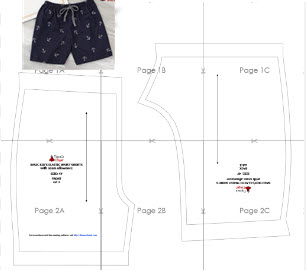
Creating a basic shorts sewing pattern is a fantastic project for sewists of all levels. Here’s a step-by-step guide to help you make a simple shorts pattern.
Materials Needed:
- Large sheet of paper (pattern paper or large tracing paper)
- Pencil
- Measuring tape
- Ruler
- French curve (optional but helpful)
- Scissors
Instructions:
1. Take Accurate Body Measurements: Measure the following:
- Waist: Measure around the narrowest part of your waist.
- Hips: Measure around the fullest part of your hips.
- Rise: Measure from your waist, down through your crotch, and up to the back waist.
2. Draw the Front Pattern:
- On the paper, draw a straight vertical line, which will be the center front (CF) line.
- From the CF line, measure and mark half of your waist measurement plus ease (e.g., 1-2 inches) and label this point as “A.”
- Measure down from point A to your desired shorts length and mark this point as “B.”
- From point B, measure and mark half of your hip measurement plus ease (e.g., 1-2 inches) and label this point as “C.”
- Draw a straight line from point A to point C.
3. Draw the Back Pattern:
- Repeat the steps for the front to create the center back (CB) line.
- For the back rise, measure up from the center back waist point (A) to your rise measurement and mark this point as “D.”
- Draw a slightly curved line from point D to point C to create the back crotch curve.
4. Draw the Waistband:
- Measure and mark a point on the center back waistline, about 2-3 inches from the CB line (depending on the width of the waistband you desire). Label this point as “E.”
- Draw a straight line connecting point E to point A (center front waistline).
5. Draw the Leg Openings:
- For the front, measure and mark a point on the center front line, about 2-3 inches below point C, and label this point as “F.”
- For the back, measure and mark a point on the center back line, about 2-3 inches below point C, and label this point as “G.”
- Draw a slightly curved line from point F to point G for the front and back leg openings.
6. Finish the Pattern:
- Add seam allowances (usually ⅝ inch) to all pattern edges, except the waistband, where you should add a larger allowance to accommodate elastic or a drawstring casing.
- Label the pattern pieces, indicating the cut on fold (for front and back), and note any other important information.
- Cut out the pattern pieces and test them by pinning them together to check the fit.
Remember, this is a basic shorts pattern, and you can modify it by adding pockets, cuffs, or other design elements to create different styles. Always make a toile (a test garment) with cheaper fabric before cutting your final shorts to ensure the fit and make any necessary adjustments. Enjoy your sewing project!