
Delve into the world of quality at bat charts, an indispensable tool for baseball teams seeking to optimize their batting performance. This comprehensive guide unravels the intricacies of this valuable metric, empowering coaches and players alike to make informed decisions that drive team success.
Quality at bat charts provide a granular analysis of each batter’s performance, revealing patterns and trends that can significantly enhance team strategy. By understanding the metrics and data points involved, interpreting the chart effectively, and utilizing its insights to identify strengths and weaknesses, teams can gain a competitive edge on the field.
Contents
Understanding Quality at Bat Chart

A quality at bat chart is a valuable tool for baseball analysts and coaches to evaluate a batter’s performance and identify areas for improvement. It provides insights into the quality of a batter’s at-bats, beyond traditional metrics like batting average and home runs.
The chart typically includes data points such as:
- Batting average on balls in play (BABIP)
- Line drive percentage
- Ground ball percentage
- Fly ball percentage
- Strikeout percentage
- Walk percentage
By analyzing these metrics, analysts and coaches can gain a better understanding of a batter’s approach at the plate, their ability to make solid contact, and their overall effectiveness. This information can be used to develop strategies to improve the batter’s performance and maximize their potential.
Interpreting Quality at Bat Chart

Interpreting a quality at bat chart requires careful analysis of the data to identify trends and patterns that can inform decision-making. The chart provides valuable insights into the performance of individual batters and the overall quality of their at-bats.
Identifying Trends and Patterns
- Strikeout rate: A high strikeout rate indicates that a batter is struggling to make contact with the ball. Identifying the reasons for the high strikeout rate, such as poor pitch recognition or swing mechanics, is crucial.
- Walk rate: A high walk rate suggests that a batter is patient at the plate and has good pitch recognition. However, a very high walk rate may indicate that the batter is being too passive and not swinging at hittable pitches.
- Batting average on balls in play (BABIP): BABIP measures the batter’s luck in putting the ball in play. A high BABIP may indicate that the batter is hitting the ball hard and finding holes in the defense, while a low BABIP may suggest that the batter is hitting the ball weakly or is unlucky.
- Isolated power (ISO): ISO measures a batter’s power by isolating the extra-base hits from the singles. A high ISO indicates that the batter has the ability to hit for extra bases, while a low ISO suggests that the batter is more of a contact hitter.
- Weighted on-base average (wOBA): wOBA is a comprehensive metric that takes into account all of the different ways a batter can reach base. A high wOBA indicates that the batter is getting on base frequently and is a valuable contributor to the offense.
By understanding these trends and patterns, teams can make informed decisions about how to improve their offensive performance. For example, a team with a high strikeout rate may need to work on improving their pitch recognition, while a team with a low BABIP may need to focus on hitting the ball harder.
Utilizing Quality at Bat Chart
A quality at-bat chart can be a valuable tool for improving team performance. By tracking the number of quality at-bats each player has, coaches can identify strengths and weaknesses in a team’s batting approach. This information can then be used to develop strategies to improve the team’s overall performance.
One way to use a quality at-bat chart is to identify players who are consistently getting good swings on the ball. These players are typically the ones who are making solid contact and hitting the ball hard. Coaches can then work with these players to help them improve their batting skills even further.
Another way to use a quality at-bat chart is to identify players who are struggling to make good contact with the ball. These players may be striking out too often, or they may be hitting the ball weakly. Coaches can then work with these players to help them improve their swing mechanics and their overall approach to hitting.
By using a quality at-bat chart, coaches can gain a better understanding of their team’s batting strengths and weaknesses. This information can then be used to develop strategies to improve the team’s overall performance.
Identifying Strengths and Weaknesses
A quality at-bat chart can be used to identify strengths and weaknesses in a team’s batting approach. By tracking the number of quality at-bats each player has, coaches can see which players are consistently getting good swings on the ball and which players are struggling to make contact.
This information can then be used to develop strategies to improve the team’s overall performance. For example, if a team has a lot of players who are striking out too often, the coaches may decide to work with those players on their swing mechanics. Or, if a team has a lot of players who are hitting the ball weakly, the coaches may decide to work with those players on their approach to hitting.
By using a quality at-bat chart, coaches can gain a better understanding of their team’s batting strengths and weaknesses. This information can then be used to develop strategies to improve the team’s overall performance.
Comparing Quality at Bat Charts
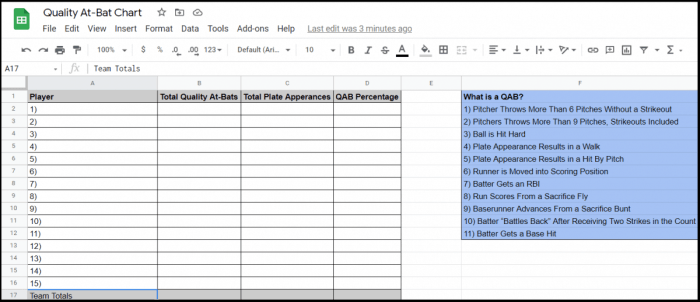
Comparing quality at bat charts between different teams or players can provide valuable insights into their batting performance. By examining the distribution of outcomes, you can identify strengths and weaknesses, as well as areas for improvement.
Identifying Significant Differences, Quality at bat chart
To identify significant differences in batting performance, consider the following methods:
- Statistical Tests: Conduct statistical tests, such as the t-test or ANOVA, to determine if there are statistically significant differences between the quality at bat charts of different teams or players.
- Visual Inspection: Compare the charts visually to identify notable differences in the distribution of outcomes. Look for patterns, trends, or outliers that may indicate significant differences.
- Contextual Analysis: Consider the context surrounding the data. Factors such as team strategy, ballpark dimensions, and opposing pitchers can influence batting performance and should be taken into account when comparing quality at bat charts.
By comparing quality at bat charts and using these methods to identify significant differences, you can gain a deeper understanding of the batting performance of different teams or players and make informed decisions about strategy and development.
Creating a Quality at Bat Chart

Creating a quality at-bat chart involves several steps to effectively track and analyze the performance of batters.
Selecting the Appropriate Data and Metrics
The first step in creating a quality at-bat chart is to select the appropriate data and metrics to include. This may vary depending on the specific goals and objectives of the analysis. Some common data points and metrics used in quality at-bat charts include:
- Batting Average
- On-Base Percentage
- Slugging Percentage
- Walks
- Strikeouts
- Home Runs
- Groundouts
- Flyouts
- Lineouts
- Quality of Contact
- Exit Velocity
- Launch Angle
These metrics provide a comprehensive view of a batter’s performance and can be used to identify areas for improvement and make informed decisions.
Closure

In conclusion, quality at bat charts are an invaluable asset for baseball teams seeking to elevate their batting performance. By leveraging the insights gleaned from these charts, coaches can make informed decisions, identify areas for improvement, and develop strategies that maximize their team’s potential. Embracing the power of quality at bat charts empowers teams to optimize their batting approach, ultimately leading to enhanced team success and a competitive advantage on the field.
FAQ Explained: Quality At Bat Chart
What is the purpose of a quality at bat chart?
Quality at bat charts provide a comprehensive analysis of each batter’s performance, identifying strengths and weaknesses to inform strategic decision-making and improve team performance.
How do I interpret a quality at bat chart?
Interpreting quality at bat charts involves analyzing metrics such as batting average, on-base percentage, slugging percentage, and strikeout rate to identify trends and patterns that reveal a batter’s overall performance.
How can I use a quality at bat chart to improve my team’s performance?
By identifying strengths and weaknesses in a team’s batting approach through quality at bat charts, coaches can develop targeted strategies to enhance performance, optimize lineup construction, and make informed decisions during games.