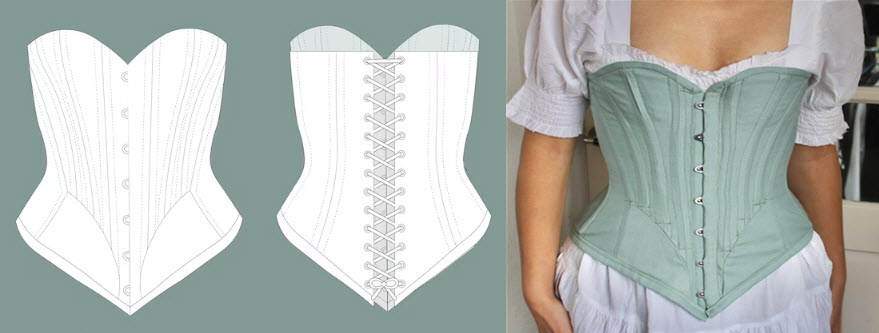
Creating a corset sewing pattern requires careful measurements and attention to detail. Below, I'll provide a basic outline for drafting a simple overbust corset pattern. Keep in mind that corset making involves precision, so take accurate measurements and make a mock-up (toile) before using your final fabric.
Materials:
- Large sheets of paper or pattern drafting paper
- Pencil
- Ruler
- Measuring tape
- French curve (optional)
- Tracing paper (optional)
Steps:
- Take Measurements:
- Bust: Measure the fullest part of the bust.
- Underbust: Measure under the bust, where the bottom edge of the corset will sit.
- Waist: Measure the natural waist, which is the narrowest part of the torso.
- Hip: Measure the fullest part of the hips.
- Draft the Front Panel:
- Draw a vertical line on the paper representing the center front (CF).
- Mark points for the bust, underbust, waist, and hip measurements along the CF.
- Connect these points with a smooth curve to create the front panel. Ensure the curve is gradual for a flattering fit.
- Draft the Back Panel:
- Draw a parallel line to the CF, representing the center back (CB).
- Mark points for the underbust, waist, and hip measurements along the CB.
- Connect these points with a smooth curve to create the back panel.
- Add Seam Allowance:
- Add seam allowance (typically 1/2 inch or 1.27 cm) to all edges of the front and back panels. This is important for sewing the pieces together.
- Draft Side Panels:
- Divide the front and back panels into equal sections (usually 4-6) for side panels.
- Draw lines perpendicular to the CF and CB, connecting them with the front and back panels.
- Add seam allowance to all edges of the side panels.
- Waist Tape Placement:
- Optional: Add channels for waist tape by drawing parallel lines along the waistline, about 1/2 inch (1.27 cm) apart.
- Mark Boning Channels:
- Add boning channels on each seam line and along the center front and center back.
- Make channels wide enough for your chosen boning (typically 1/2 inch or 1.27 cm).
- Final Check:
- Ensure all panels match up along the seams.
- Double-check measurements and compare them to your actual body measurements.
- Toile/Mock-up:
- Before cutting your fabric, create a toile using muslin or a similar inexpensive fabric.
- Test the fit and make adjustments as needed.
- Cutting and Sewing:
- Transfer your final pattern to your chosen fabric.
- Sew the pieces together, inserting boning into the channels.
- Install a busk or other closure method at the center front.
Remember, corset making is a skill that improves with practice. Feel free to customize the pattern based on your preferences and experiment with different fabrics, boning types, and decorative elements.