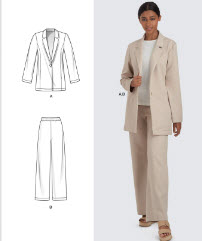
Creating detailed sewing patterns requires visual diagrams and measurements, which cannot be effectively conveyed through text alone. However, I can provide you with a general outline of the steps involved in creating a women's suit sewing pattern:
Materials Needed:
- Tracing paper or pattern paper
- Measuring tape
- Ruler
- Pencil or pen
- French curve (optional, for smooth curves)
Steps:
- Take Measurements: Measure the person's bust, waist, hips, back waist length, shoulder width, arm length, and any other relevant measurements. Ensure accurate measurements for a well-fitting suit.
- Create Basic Block: Start by drafting a basic block for a fitted jacket and trousers. This is a simple pattern that will serve as a foundation for your suit pattern.
- Draft Jacket Pattern: Using the basic block as a guide, start drafting the jacket pattern. You'll need to add features like darts, princess seams, collars, lapels, sleeves, and pockets. Refer to fashion design and patternmaking books or online resources for guidance on how to create these elements.
- Draft Trousers Pattern: Similar to the jacket, use the basic block to draft the trousers pattern. Include features like waistband, pockets, pleats, and a zipper or button closure.
- Test Fit: Once you've drafted the patterns, create mock-ups using inexpensive fabric to test the fit. Make adjustments to ensure the patterns fit well and are comfortable.
- Finalize Patterns: After you're satisfied with the fit and design, transfer your adjusted patterns onto pattern paper or tracing paper. Use a ruler and French curve as needed to create smooth lines and accurate curves.
- Add Seam Allowances: Add seam allowances to your pattern pieces. The standard seam allowance is usually 5/8 inch (1.5 cm), but you can adjust this based on your preference.
- Label Pattern Pieces: Clearly label each pattern piece with its name, size, grainline, and any other important information.
- Instructions: Along with your pattern pieces, create detailed sewing instructions. Explain how to assemble the suit, step by step.
- Include Notches: Add notches to your pattern pieces to help align seams and other elements during sewing.
- Create a Layout Diagram: Design a layout diagram that shows how to place your pattern pieces on fabric, considering grainlines and fabric width.
- Test Again (Optional): For your own reassurance and to ensure accuracy, create another mock-up using your finalized patterns.
- Package Your Pattern: Organize your pattern pieces, instructions, and layout diagram neatly. You can digitize them for sharing, or if you plan to sell the pattern, consider professional packaging.
Remember that pattern-making is a skill that takes practice to master. It's advisable to start with simpler projects before attempting more complex items like suits. Additionally, you might want to explore pattern-making software that can assist you in creating accurate patterns digitally.