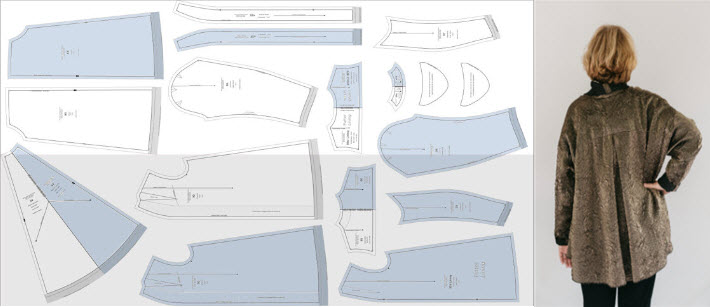
Creating a swing coat sewing pattern involves drafting pattern pieces that capture the loose and flowing silhouette of a swing coat. Here's a guide on how to create a basic swing coat pattern:
Materials Needed:
- Outer fabric (wool, tweed, or other coat-weight fabric)
- Lining fabric (satin, polyester, etc.)
- Sewing machine
- Thread
- Scissors
- Measuring tape
- Pins
- Pattern paper or large pieces of paper
- Pencil or pen
- Interfacing (if needed)
- Buttons or closures
Steps:
- Take Measurements: Measure your bust, waist, hips, and desired coat length.
- Drafting the Pattern: Create a basic pattern using your measurements and the following steps:
Back Piece:
- Draw a vertical line representing the center back (CB) of your coat pattern.
- From the top, mark down the length of the coat.
- At the top, mark your desired neckline, usually a little lower than your collarbone.
- Measure your bust measurement divided by 4 and mark it on the shoulder level.
- From the bust mark, measure down to your waist measurement divided by 4 and mark it.
- Connect the bust and waist marks with a slightly curved line.
- Add seam allowances to the sides, shoulder, and hem (usually 1/2 to 1 inch).
Front Piece (Single Piece with Button Placket):
- Use the back piece as a reference for the shoulder width and neckline.
- Draw a vertical line representing the center front (CF) of your coat pattern.
- Mark your desired neckline, usually a little lower than your collarbone.
- Extend the line downwards for your desired coat length.
- Measure your bust measurement divided by 4 and mark it on the shoulder level.
- From the bust mark, measure down to your waist measurement divided by 4 and mark it.
- Connect the bust and waist marks with a slightly curved line.
- Add seam allowances to the sides, shoulder, and hem (usually 1/2 to 1 inch).
- Add a center front line for the button placket, and add an extra width for the placket itself (usually about 2-3 inches).
- Sleeves:
- Draft a sleeve pattern piece based on your arm circumference and desired sleeve length. A slightly wide and flared sleeve works well for a swing coat.
- Cutting the Fabric:
- Pin the pattern pieces onto your outer fabric and lining fabric and cut them out. Cut two front pieces (mirrored), one back piece, and two sleeve pieces (mirrored) from both the outer fabric and the lining fabric.
- Interfacing (if needed):
- Apply interfacing to the collar, button placket, and any other areas that need structure and stability.
- Sewing:
- Sew the darts on the front and back pieces to create shaping.
- Sew the front and back pieces together at the shoulder seams.
- Attach the sleeves to the armholes, matching notches, and easing in any excess fabric.
- Lining:
- Sew the lining front and back pieces in the same manner as the outer fabric.
- Sew the lining sleeves to the lining body.
- Joining Outer Fabric and Lining:
- With right sides together, sew the lining and outer fabric together at the neckline and front edges. Leave the bottom hem open.
- Button Placket:
- Fold the button placket area on the front piece along the center front line. Press the fold.
- Fold the other side over the folded placket, creating a pleat-like effect. Press the folds.
- Topstitch along the folded edges to secure the placket.
- Hemming:
- Hem the coat by folding the bottom edge of the outer fabric and the lining, then sewing in place.
- Buttonholes and Buttons:
- Create buttonholes on the button placket, usually spaced evenly.
- Sew buttons on the opposite side of the buttonholes.
- Try On and Adjust:
- Try on the coat to ensure a comfortable fit. Make any necessary adjustments to the fit or length.
- Finishing Touches:
- Trim any loose threads, press the seams, and ensure that the coat is neatly finished.
Remember that this is a basic guide, and you can customize your swing coat pattern by adding a collar, pockets, or other design elements. Be patient and take your time with the sewing process to ensure a well-fitting and stylish swing coat.